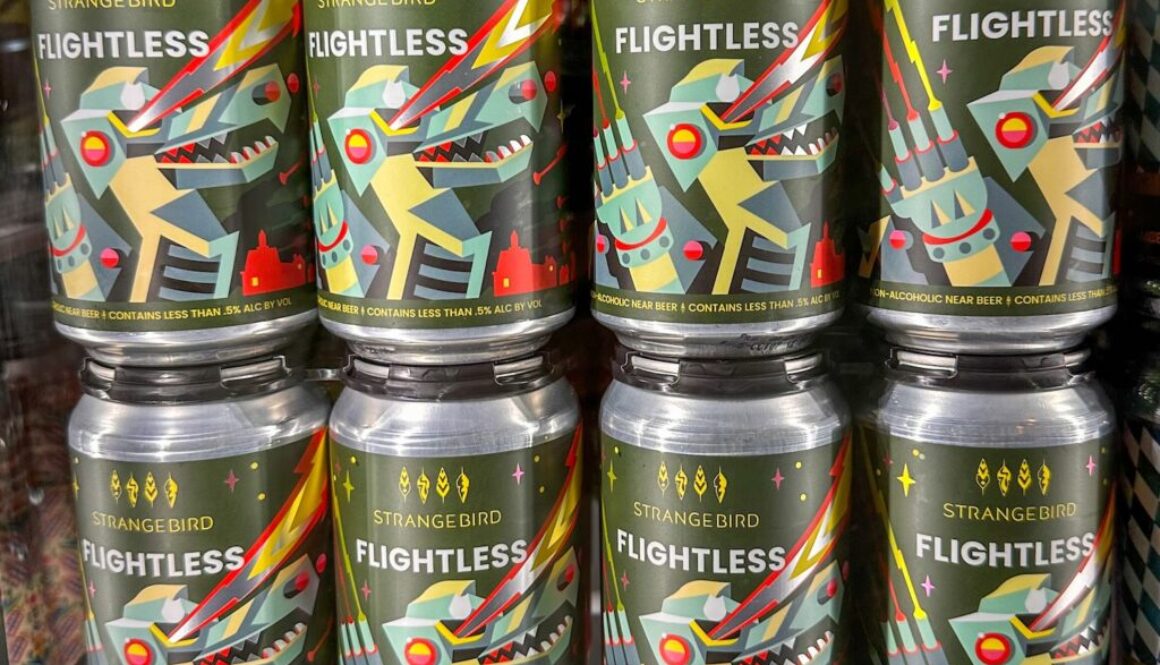
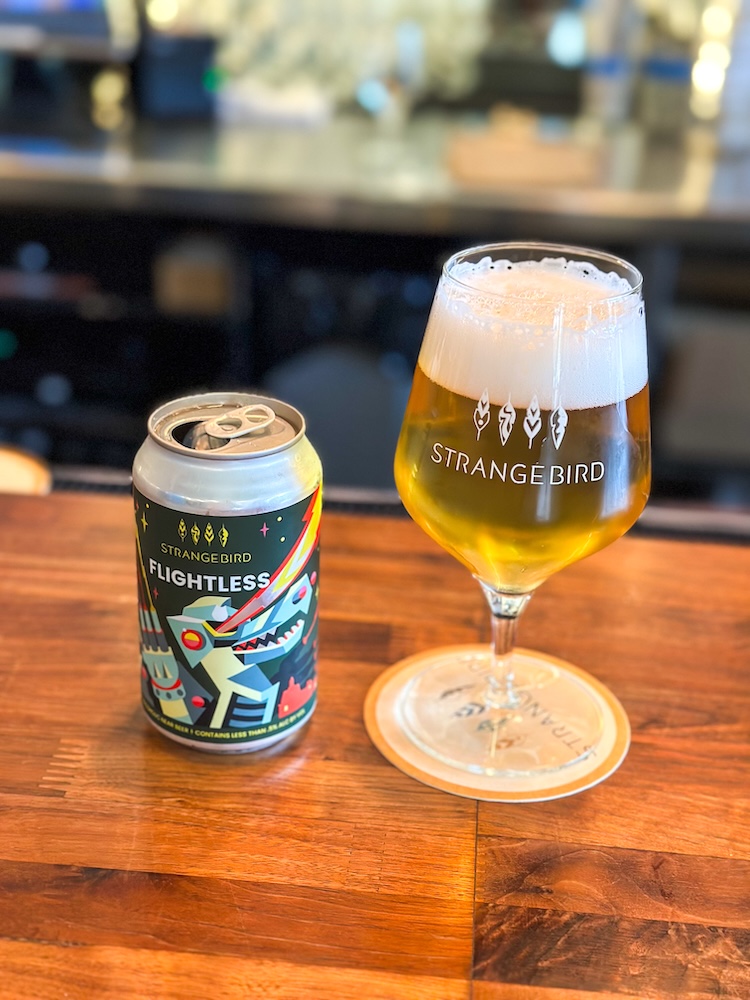
For as long as I can remember, Strangebird has been serving Industrial Arts nonalcoholic line of beers. They’ve also always had a few nonalcoholic options in addition to the Industrial Arts beers, like house-made sodas and kombucha. Just this week though they upped the ante and have released their own nonalcoholic beer.
According to their menu, their new nonalcoholic Flightless lager was made in collaboration with Industrial Arts. The Hudson Valley brewery was already contract brewing some other nonalcoholic beers, so it was probably a natural choice.
Strangebird’s nonalcoholic lager was made with Perle and Hallertau Mittelfrüh hops. The flavor is light and crisp, and fits in perfectly with brews described as “crushable”.
At $6.00 a can right at the brewery, it’s easily one of the least costly nonalcoholic beers you can find. Or, you can grab a six pack for $15.00 to bring home.
Each week I post a single survey question on the nonrocaholic Instagram to gain a bit of insight about how people make decisions about nonalcoholic beverages. This week, I wanted to know what might make customers pick a nonalcoholic drink while at a bar or restaurant. The results heavily favored one answer, and while I expected that answer to be selected the most, I didn’t expect the disparity between that and the second most popular vote.
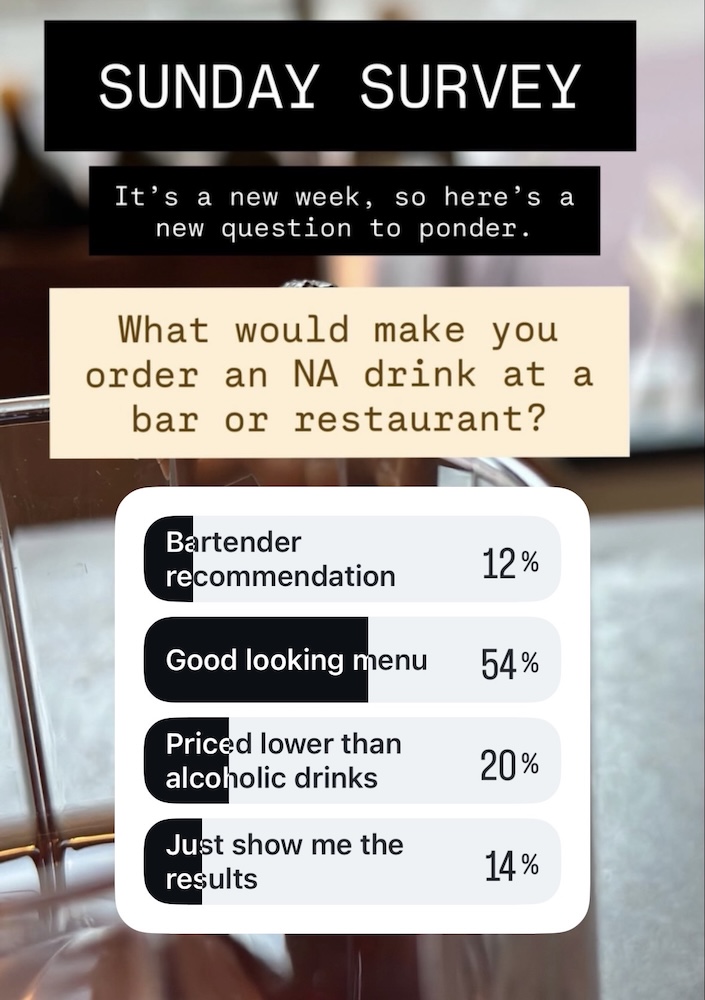
The question was: What would make you order an NA drink at a bar or restaurant?
Instagram only allows for three choices, and I always make it option to abstain from voting to see the results. (I do this in case people want to engage, but the question doesn’t apply to their habits.)
The options were:
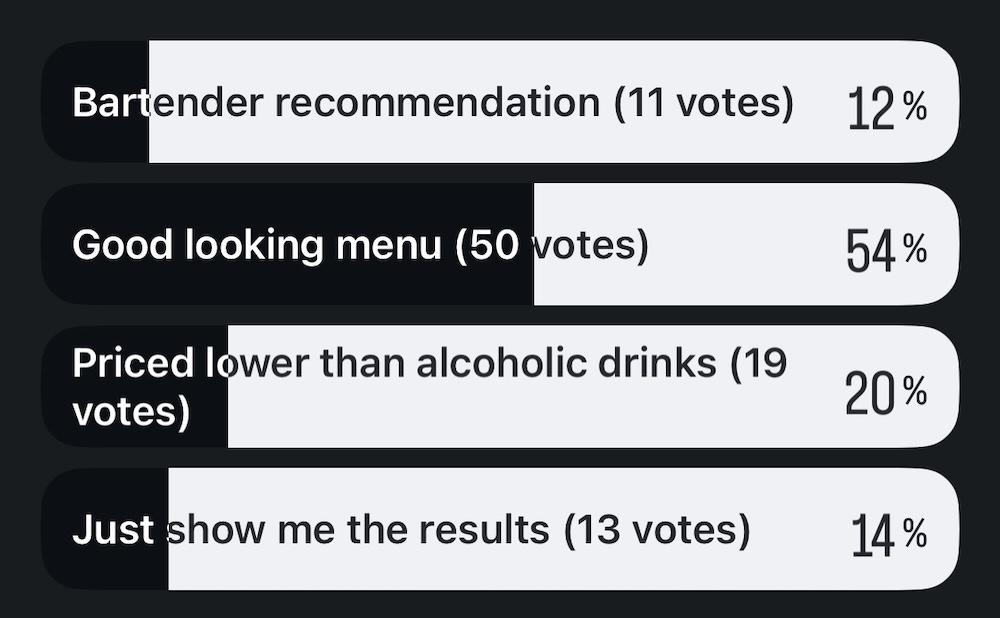
Bartender recommendation
Good looking menu
Priced lower than alcoholic drinks
Screenshot
Results
Out of 93 total respondents, 54% said that a good looking menu made them order a non-alcoholic drink. Then 20% said that price impacted their decisions. Just 12% said they’d rely on the bartender’s recommendation.
The remaining 14% elected to just view the results.
Screenshot
Note: Respondents of course are followers of nonrocaholic on Instagram and who happened to see this Instastory when it was available. The survey’s results don’t necessarily reflect a wide range of consumers, though may be indicative of a larger polling group.
Discussion
There are a lot of restaurants that just simply write on a menu that if a patron wants a nonalcoholic drink to just ask. There’s a bunch of problems with that, but what this particular survey shows is that more than half of respondents want to be able to read what’s available right on the menu. That means, if it’s not on the menu, maybe they’re among those who would ask a bartender (or wait staff), but instead they may just choose a cheap option like soda, or even stick with water.
People wanting nonalcoholic options could always ask. We’re experienced enough in knowing how to ask if a bartender can make a Moscow Mule without the alcohol. Plus, if the menu says, “we can make most of our cocktails as nonalcoholic versions” there are some questions I’d want to know before ordering. If I’m ordering an Old Fashioned as a nonalcoholic drink, did they just simply leave the whiskey out? If so, I’d basically be drinking bitters with sweetener and water. Or, do you have a nonalcoholic whiskey alternative to use?
If you just simply list the nonalcoholic drinks your staff can make, then consumers can make an educated decision about what they’d like. If not, you could be creating a speed bump in the selection process your patrons are making when they order.
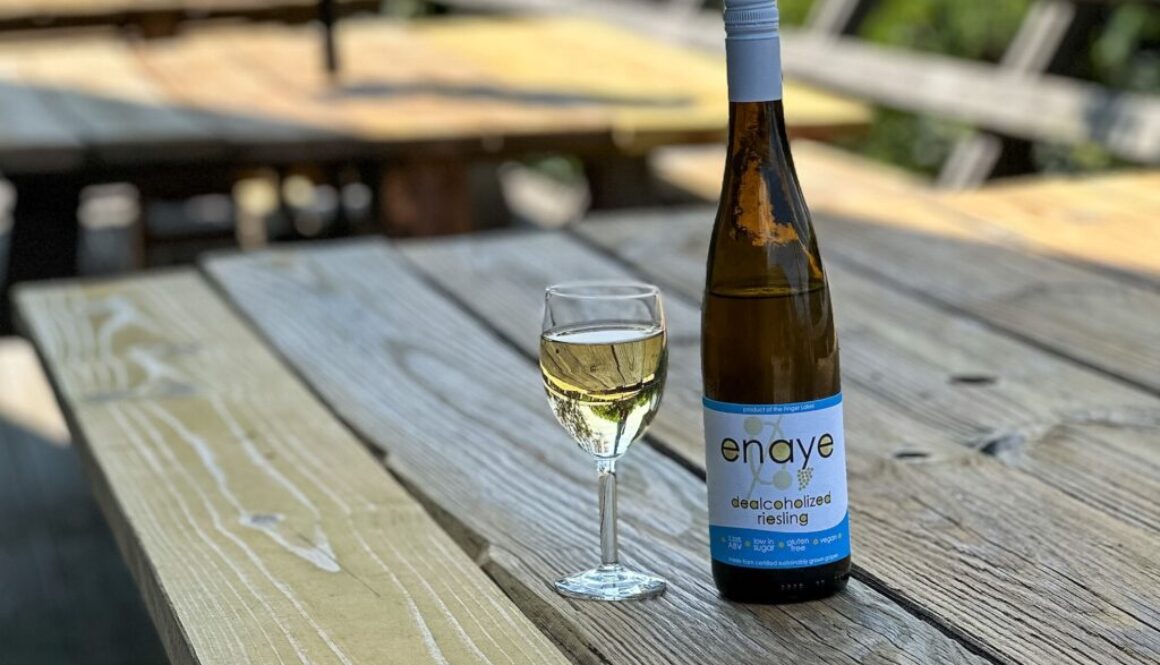
Last year at this time we had zero nonalcoholic wines. The fact that I’ve now discovered two this summer is quite promising. Wagner Vineyards Estate Winery on the east side of Seneca Lake has joined the nonalcoholic wine fun. They’ve recently released a nonalcoholic Riesling called enaye.
This wine is of particular interest for me. Many years ago Wagner is actually the place that my local, craft nonalcoholic obsession began. They’ve been bottling a blush grape juice for many years and it’s been a go-to option for me. It doesn’t feel like any old grape juice because it’s locally grown grapes and locally pressed. It’s in a really nice looking grown-up looking bottle. Plus, their brewery makes their own in-house root beer, so I’ve been going here for years to enjoy both options.
The Finger Lakes Region is known in particular for Riesling wines. The climate and growing conditions here in this region are ideal for the higher acidity in Riesling grapes. The cold-hardy grape is able to survive our brutal winters, and even thrive in spite of them.
Enaye is German for “without”, so the name represents what the wine doesn’t have–which is alcohol. They fermented and produced a Riesling wine the same way they would any other. Then it was trucked down to Virginia and put through a rigorous dealcoholization process at Wine and Beer Supply. Then the 0.33% ABV Riesling was bottled back here in the Finger Lakes.
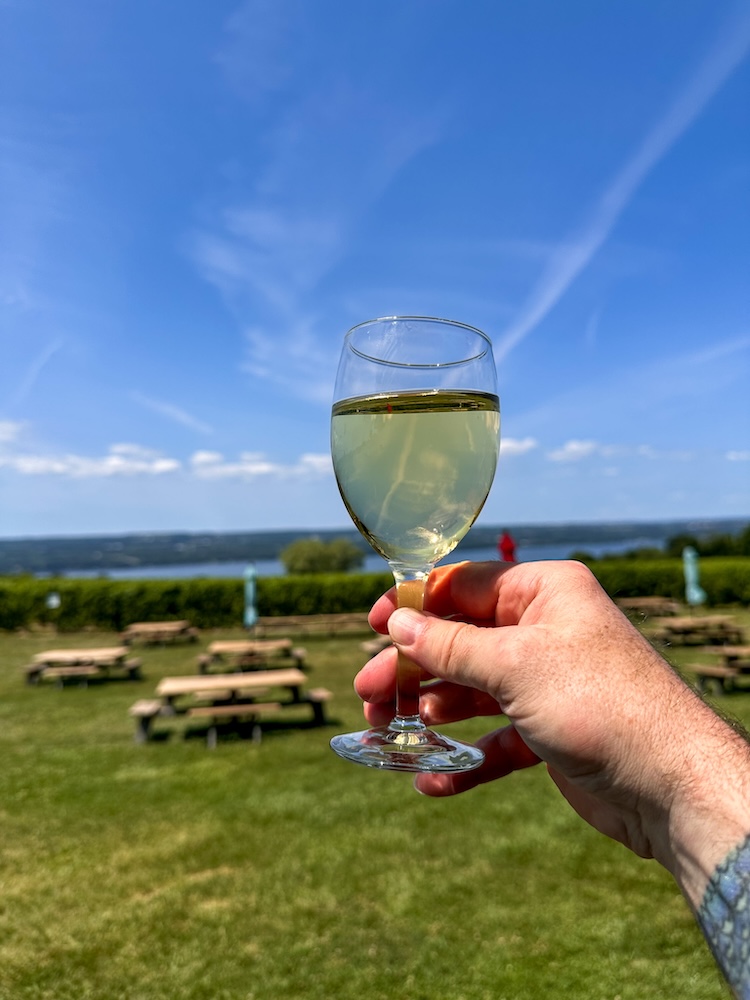
You can pick up a bottle in the tasting room on Seneca Lake for $23.00, or also enjoy a glass on site for $8.00. Wagner’s winery and brewery are adjoined and sit on a really great plot of land looking west over the lake. There’s plenty of good spots to sit on site and enjoy a glass!
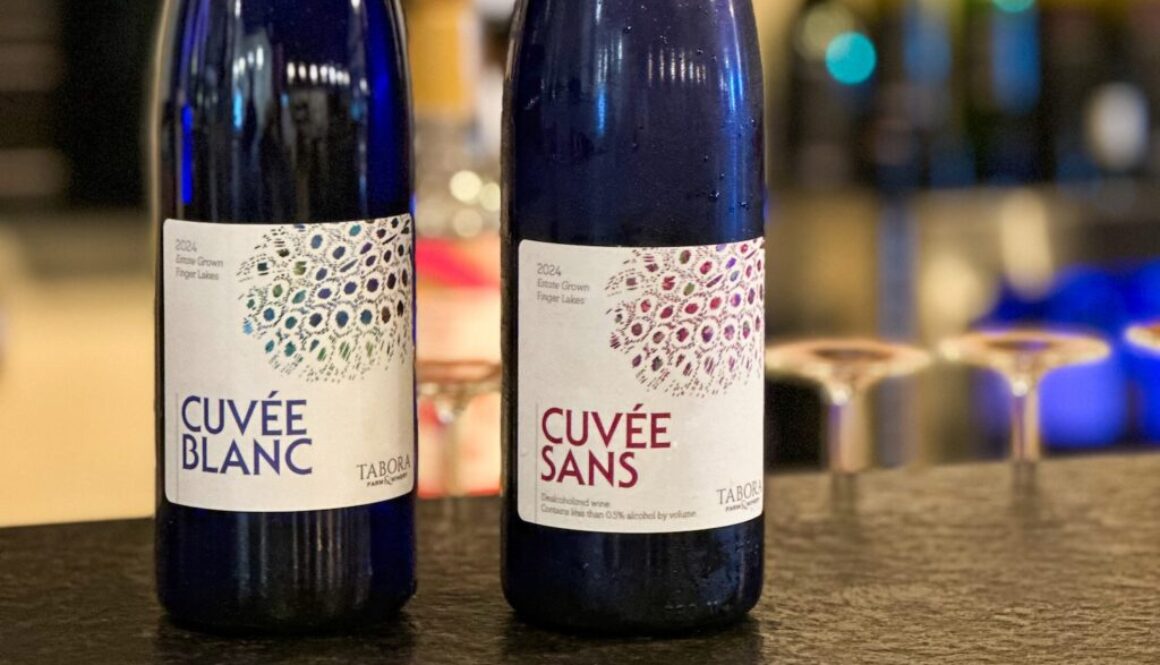
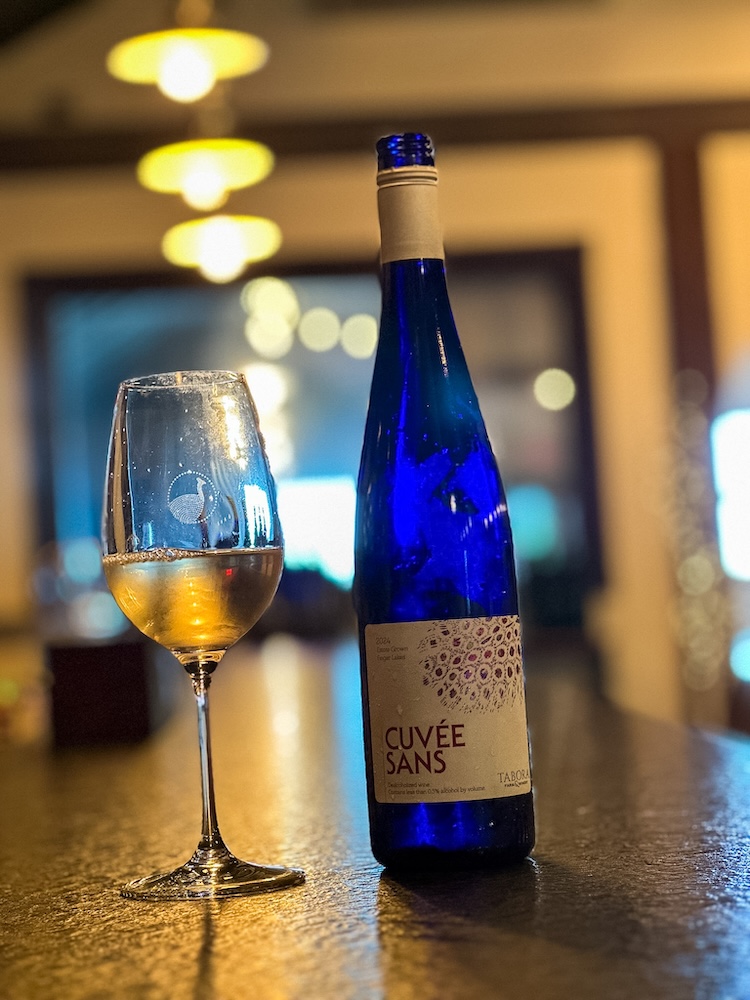
I’ve been visiting Tabora Winery on Seneca Lake for years now. They have a real nice bakery and kitchen on site with simple menu items like soups and sandwiches. While they’ve never had any wine that I could enjoy, their quick-fix lunch menu makes for a perfect stop. I just discovered a new reason to visit: they have a nonalcoholic wine bottled under their own label! They recently just quietly released a nonalcoholic version of their Cuveé Blanc, which they’re calling Cuveé Sans.
This nonalcoholic white wine features a blend of three locally grown grapes: Riesling, Cayuga White, and Aurore grapes.
The Cuveé Blanc was taken to Virginia where it was dealcoholized by Wine and Beer Supply. Using a couple methods, the wine was dropped down below the 0.5% ABV required to qualify as nonalcoholic here in the U.S.
Local Nonalcoholic Wines
This wine is somewhat special because it’s likely the first nonalcoholic Finger Lakes wine. I’ve been watching the nonalcoholic beverage scene here locally for many years but it’s certainly possible that one slipped by me. In fact, this Tabora nonalcoholic wine has actually been out for many months. I heard through the grapevine that they were offering a nonalcoholic wine and I stopped to see what brand they had.
I couldn’t believe my surprise to learn it was their own label!
Get Cuveé Sans
Right now the nonalcoholic Cuveé Sans is only available at the Tabora Winery tasting room off Route 14 in Dundee. Bottles retail for $23.00 each. You can also get it by the glass and even as an ingredient in a mocktail.
The Finger Lakes Region just got its first entirely nonalcoholic bar right on Main Street in Canandaigua. Vital Garnish is a mocktail bar with a small bites menu offering a bar-like atmosphere but no booze. Leah Fricano of Rochester is the owner of Vital Garnish which opened the last weekend in December. She wanted to offer people a place to have fun and engage others without the need for alcohol.
She said that it felt right to get a little distance outside of Rochester and closer to the Finger Lakes. “It gives people an opportunity to take a little drive and anticipate the experience.” Plus, she really enjoys the Main Street vibe with the collection of shops, interesting history, unique architecture, and local culture.
Drinks Menu
The “Swigs” menu is described as an “ever-changing low/no sugar N/A cocktails to excite the pallet [sic] & occupy the drinkin hand”. Drinks like the “Beets Me” with lemon spritz, beet syrup, and muddled apple or the “Cranberry Zing” featuring Seedlip zeroproof botanical spirits use a wide range of ingredients to craft interesting, bespoke mocktails.
Vital Garnish has a huge curio cabinet where visitors can select their own glass for their drink. Because customers can choose their own glass, the aesthetic of each drink will always be different and interesting.
For those not wanting a more complex drink, they’re also serving Coke products and Minute Maid lemonades. (Though the lemonades can also be elevated by adding flavored house made syrups!
Vital Garnish also has an appetizer-style menu with a handful of small bites available.
More About Vital Garnish
For more information you can visit the Vital Garnish website and Instagram.
Earlier this summer Ellicottville Brewing Company surprised us all when they released a nonalcoholic version of their popular Blueberry Wheat beer. Though there’s often excitement around the release of local nonalcoholic products, this one caught the attention (and spurred the enthusiasm) of a lot of folks.
It was the first fruited nonalcoholic beer to be canned in Upstate New York so it was somewhat unique. As reviews started turning out, it was clear that everyone was loving it.
What we didn’t realize was that while we were celebrating a new product that we really loved, EBC was already quietly working behind the scenes on their second release.
NA Blackberry Kölsch
In early October the brewery announced the release of a second nonalcoholic beer. This time they were canning a 0.3% ABV version of their Blackberry Kölsch. Like the previous brew, this is entirely brewed and canned in their facility in Cattauragus County.
Ellicottville Brewing Company’s nonalcoholic Blackberry Kölsch is available in cans right at the brewery and can be purchased in retailers where you find other EBC products.
Ellicottville Brewing Company just became the newest brewery in Upstate New York to release their own nonalcoholic beer. In early July they announced their first ever NA brew on social media. Their first non-alc brew is a less than 0.5% ABV version of their wildly popular Blueberry Wheat.
According to their website the nonalcoholic Blueberry Wheat beer is produced entirely in-house at their production facility in Cattauragus County. The new brew is one of only a few nonalcoholic beers produced in Western New York. Plus, it is likely the only fruited nonalcoholic beer in all of Upstate.
As more Americans choose to drink less alcohol, breweries everywhere are trying to find ways to accommodate customers with options. While producing a nonalcoholic beer has gotten more approachable for breweries, it’s still complex and can be costly.
The new nonalcoholic Blueberry Wheat from Ellicottville Brewing Company is available in cans only right now. It’s available at each of the Ellicottville Brewing locations, but it’s also sold in stores around Upstate.
When Dry A.F. Craft Beverage Shop opened in early March 2024, it became one of the first nonalcoholic bottle shops in Upstate New York. Owned by Jennifer Barnett, the small storefront on Main Street in Schoharie originally occupied half the space. Within six months, the shop expanded to fill the entire location as interest grew.
What began as a curated collection of nonalcoholic beverages quickly evolved into a community hub for the sober and sober-curious. The shop offered a welcoming space for those exploring alcohol-free lifestyles to discover new and interesting NA options. The variety includes dealcoholized wines, nonalcoholic beers, functional beverages, and lots more.
Dry A.F. soon became the only brick-and-mortar nonalcoholic bottle shop within several hours’ drive of Schoharie. While big box stores and supermarkets have started adding nonalcoholic products to their shelves in response to growing demand, dedicated shops like Dry A.F. provide a far broader selection. They also offer educational tastings, community-building events, and access to small-batch brands that often can’t scale to national distribution.
On July 23, 2025, the closure of Dry A.F. was announced via social media. The brick-and-mortar location is set to close its doors on October 25 of this year.
Find Place To Purchase
Dry A.F. will still maintain hours with their brick-and-mortar shop through October 25th. If you’re looking for other nonalcoholic bottle shops in Upstate New York you’ll find a list here. For a global map of nonalcoholic bottle shops you can visit an interactive map at Zero Proof Nation.
The U.S. Open Beer Championships have given out thousands of medals since they first began the competition in 2009. The contest hosts 8,000 different entries from around the country to rank in over 150 categories. The majority of the categories are all alcoholic beer, but there are a few non-alcoholic categories, and even two root beer categories and one for hop water.
This year there were six categories related to non-alcoholic beer with 18 total medals given out for near beers.
Western New York earned some bragging rights though when Big Ditch Brewing out of Buffalo was awarded a Silver Medal for Best Non-alcoholic IPA.
Big Ditch’s NA Burner
In November 2024 the Buffalo-based brewery released their NA Burner nonalcoholic IPA. Coming in at under 0.5% ABV it’s a “near beer” version of their popular Hay-Burner IPA.
Available in cans from the brewery and in stores all over Upstate New York, the NA Burner IPA has become a local favorite for good reason.
As the demand for nonalcoholic beverages continues to grow, so too does the diversity of options available to consumers. From alcohol-free craft beer to functional adaptogenic drinks, the sober curious movement is no longer a niche — it’s mainstream.
But with so many alcohol alternatives on the market, it raises an important question: What do consumers really want in a nonalcoholic beverage?
Exploring Preferences in the Sober Curious Community
People choose nonalcoholic drinks for a variety of reasons. For some, it’s a step toward better health and fewer calories. Others want a beverage that mimics the appearance of alcohol to blend in socially, while some are drawn to mood-enhancing or functional ingredients like CBD, adaptogens, or nootropics.
To better understand what drives these preferences, nonrocaholic conducted a recent Sunday Survey via Instagram, targeting sober curious individuals in the Rochester, New York area.
The Survey: What Matters Most in a Nonalcoholic Beverage?
The survey asked one central question: “What do you most look for in a nonalcoholic beverage?”
Instagram polls are limited in space, so participants were given three response options, plus the choice to simply view the results:
A flavorful experience — for those who prioritize taste and quality.
Functional, mood-boosting properties — including drinks with calming, energizing, or psychoactive effects (like CBD, magnesium, or THC).
Simple and low-calorie — ideal for people focused on clean, light refreshment with minimal ingredients.
Survey Results
Total views: 218 people saw the poll
Total responses: 72 votes (6 chose to only view results)
Top priority: Flavor
48 respondents (67%) chose “a flavorful experience” as their top priority when choosing nonalcoholic drinks.
While the survey didn’t dive into specifics, this category could include everything from L-theanine and Lion’s Mane to hemp-derived THC beverages.
Low-calorie options:
10 respondents (14%) indicated a preference for simple, low-calorie drinks.
Key Takeaways
Although this was an informal poll targeting nonrocaholic’s Instagram followers, the results offer a snapshot of consumer interest — particularly within the sober curious and alcohol-free community.
Flavor clearly dominates the list of priorities. While functionality and health benefits matter to some, the majority of respondents simply want a nonalcoholic beverage that tastes great.
This aligns with broader trends in the beverage industry, where premium flavor profiles and quality ingredients are helping brands stand out in a rapidly growing market.
Conclusion
Whether it’s for wellness, social ease, or a night off from drinking, today’s nonalcoholic beverage consumers are thoughtful and selective. But if this survey is any indication, great taste remains king.
As the nonalcoholic category expands, brands that prioritize flavor — while also offering functional benefits or low-calorie options — will likely resonate most with today’s evolving drinkers.